
Okay, let’s put on our ancient sandals for a minute and think about this using what we know today.
In Numbers 11, the Hebrews have reached their limit with manna. Breakfast? Manna. Lunch? Manna. Dinner? You guessed it… manna. At this point they’re probably searching the desert for the nearest five-star Egyptian restaurant.
So they ask for meat.
According to the story, God responds by sending an absolutely absurd number of quail. The birds are apparently so exhausted they barely fly, so the people gather them by the truckload (or camel-load) and begin the world’s largest all-you-can-eat quail buffet.
Then…
God sends a plague because they wanted meat.
Maybe.
Or maybe something far more ordinary happened.
We know the first five books of the Bible reached their final form centuries after the events they describe, drawing on older oral traditions and written sources. That gives plenty of time for real events, legends, and theology to become intertwined.
So here’s a possible scenario—not a truth claim, just a thought experiment.
A group of people stumbles upon a massive flock of exhausted birds. They think they’ve hit the prehistoric lottery. They gather as many as they can carry. Unfortunately, some of the birds are diseased, contaminated, or spoiled. They feast like there’s no tomorrow…
…and for some of them, there isn’t.
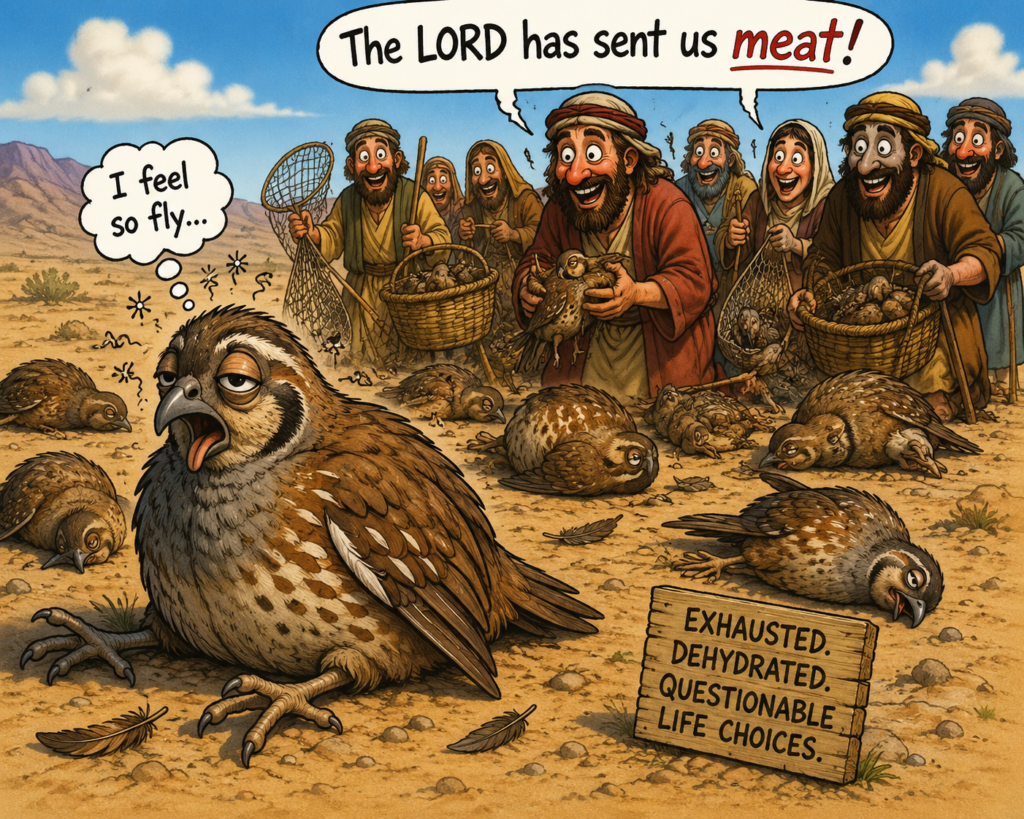
Now put yourself in the ancient world. There are no microscopes. No germ theory. No food inspectors. No FDA. No one saying, “Maybe don’t eat the birds that look like they just lost a fight with a garbage dump.”
So what’s the obvious explanation?
“God is angry.”
Today we’d ask very different questions.
- Were the birds sick?
- Was the meat spoiled?
- Was there bacterial contamination?
- Did they accidentally poison themselves?
Those are exactly the kinds of questions modern science encourages us to ask before concluding that a supernatural being decided to turn dinner into a crime scene.
The biblical explanation is theological. A natural explanation is also possible. We simply don’t have enough evidence to know which, if either, reflects what actually happened.
But here’s the part that always makes me chuckle.
If God was truly upset that His people wanted meat…
…why send the meat?
That’s a bit like a waiter bringing you a steak, watching you take three bites, and then shouting, “Aha! That’s exactly what I was hoping you’d do!”
If the request was the problem, wouldn’t a simple “No” have covered it?
Instead, according to the story, God sends millions of birds, everyone starts eating, and then people die for eating the birds He just delivered.
It’s certainly a memorable story.
Personally, if I suddenly found myself surrounded by exhausted birds that practically wanted to be caught, my first thought probably wouldn’t be, “God has blessed us.”
It would be, “Hey… does anyone else think it’s weird that the birds don’t seem interested in escaping?”